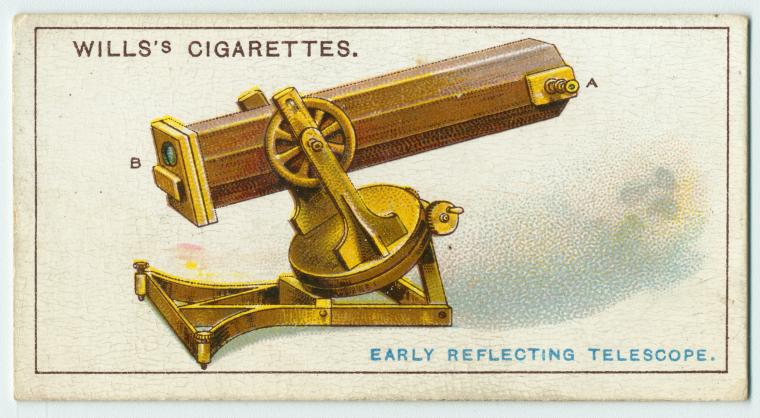
Do you know : A series of 50 (Wills's Cigarettes)
https://digitalcollections.nypl.org/items/ca800890-c54f-012f-7a92-58d385a7bc34?canvasIndex=0


The More You Drive, The Less Intelligent You Are
Got Jupiter (top), Venus (middle), and the Moon (bottom obviously). All together tonight, I love how it came out. pic.twitter.com/rFFo6d3dfz
— Jeremy Majoue (@JeremyMajoue) February 22, 2023
Tried to get it. Didn't go so well pic.twitter.com/feXtuPPOTJ
— Jeremy Majoue (@JeremyMajoue) February 23, 2023

Observing a solar eclipse on January 1, 1907, near the Cherniaevo Station in the Tian-Shan mountains above the Saliuktin mines. Golodnaia Steppe.


- This nautical astrolabe is thought to be among the earliest surviving nautical astrolabes and dates from about 1500-1520. Most nautical astrolabes had a carved mater (graduated circular element), unlike the solid and compact instrument shown here, which bears a resemblance to the astrolabes of Diogo Ribeiro (died 1533), a Portuguese cartographer and inventor who spent most of his life in Spain. The purpose of nautical astrolabes was to measure the altitude of the sun or a star above the horizon. Navigators could determine a ship's latitude by knowing the distance from the celestial equator of the sun, the polestar, or other star. This instrument is made of thick heavy bronze. Its weight would have kept it vertical despite a ship's motion in rough seas and heavy weather when it was hung from a tripod or using a plummet hanging from the axis. The graduated marks helped to hold it steady and the mobile guide on its face was pointed to the body whose height was to be measured, with the zero degree mark matching the horizon. This astrolabe is in the collections of the Christopher Columbus House Museum, in Gran Canaria.


.JPG)
.JPG)
.JPG)